Westhill Community Church
Sunday 13th July 2025
You Are Loved
Reading: John 3: 14-21
One of the many things our twenty-two month old grandson loves to play with when he visits us is this book of nursery rhymes. He will happily sit there for ten minutes or more pressing the same button over and over again, looking expectantly at us to make sure we are singing along with the tune. This week I was in the kitchen and heard him call to me from the living room, “Grand-dad … broken!” When I went in, there he was pressing the buttons, but all that came out was a repeated clicking noise. The music had stopped working. “I think the batteries need replacing,” I said, not that he understood what I was saying. I went to the battery cupboard to see if, against all expectations, we might possibly have a few spare batteries with the right code numbers on them. And to my astonishment, we did. So a few minutes later, after our grandson had meticulously scrutinised every step of the battery change operation, the nursery rhyme book was back functioning as intended.
 Our Bible reading this morning comes from a passage in
John’s Gospel in which Jesus said much the same change needs to happen to each
one of us. When something is functioning correctly, as designed and intended,
then we might say it is “righteous” – acting in exactly the right way. The
Bible says of all of us, “There is no one righteous, not even one” (Rom 3: 10).
Each of us is broken, each of us has stopped working properly as God intended,
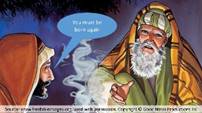
and Jesus said to Nicodemus that we need renewing deep within. “You must be
born again,” he said. Like the nursery rhyme book needed a complete battery
change so we, too, need a complete change of heart.
Our Bible reading this morning comes from a passage in
John’s Gospel in which Jesus said much the same change needs to happen to each
one of us. When something is functioning correctly, as designed and intended,
then we might say it is “righteous” – acting in exactly the right way. The
Bible says of all of us, “There is no one righteous, not even one” (Rom 3: 10).
Each of us is broken, each of us has stopped working properly as God intended,
and Jesus said to Nicodemus that we need renewing deep within. “You must be
born again,” he said. Like the nursery rhyme book needed a complete battery
change so we, too, need a complete change of heart.
Nicodemus was one of the leading Jewish teachers, a member of the Ruling Council. He was one of the most powerful and influential people in the land. He started his conversation with Jesus by saying, “We know you are a teacher who has come from God.” So it seems there were others on the Ruling Council who also believed that Jesus must be speaking and acting with God’s authority, because of the miraculous things he was doing. Now we know that most members of the Ruling Council didn’t see things that way. In fact the majority were determined to arrest Jesus and have him executed, as indeed they eventually succeeded in doing. So why were they different? Why didn’t they agree with Nicodemus that Jesus must have been speaking and acting with God’s authority? Jesus himself gave the answer. “Light has come into the world,” he said, “but people love darkness instead of light because their deeds are evil.” People are broken, he said. People cannot think or behave in the way God wants them to and intended them to, because something is broken deep within. Nobody will be able to live in God’s kingdom, he said to Nicodemus, without being born again, without a new heart, without a complete renewing of their innermost being, without the evil being removed and righteousness being bestowed.
 Well Nicodemus asked much the same question that I am sure
we would have asked, and he asked it more than once: “How can this happen, how
can this be?” And Jesus answered with an amazing picture, taken from the Old
Testament accounts of the journey of the Children of Israel from Egypt to the
Promised Land. Numbers 21 gives an account of the Israelites getting
frustrated with their long journey through the desert, so much so that they
started complaining and speaking negatively about Moses and about God himself,
even to the point of wishing themselves back in slavery in Egypt. The account
in the book of Numbers tells us that God then sent venomous snakes into the
camp, that bit many people, and many died as a result. The people then acknowledged
their sin and prayed for God’s forgiveness and for deliverance from the
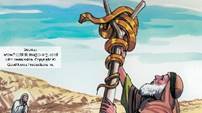
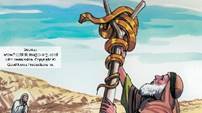
poisonous snakes. God told Moses to fashion a snake of bronze, mount it in a
large pole, and lift it up for people to see. Anyone who was bitten by a snake,
who then looked at the bronze snake on the pole, would live.
Well Nicodemus asked much the same question that I am sure
we would have asked, and he asked it more than once: “How can this happen, how
can this be?” And Jesus answered with an amazing picture, taken from the Old
Testament accounts of the journey of the Children of Israel from Egypt to the
Promised Land. Numbers 21 gives an account of the Israelites getting
frustrated with their long journey through the desert, so much so that they
started complaining and speaking negatively about Moses and about God himself,
even to the point of wishing themselves back in slavery in Egypt. The account
in the book of Numbers tells us that God then sent venomous snakes into the
camp, that bit many people, and many died as a result. The people then acknowledged
their sin and prayed for God’s forgiveness and for deliverance from the
poisonous snakes. God told Moses to fashion a snake of bronze, mount it in a
large pole, and lift it up for people to see. Anyone who was bitten by a snake,
who then looked at the bronze snake on the pole, would live.
Now this story tells us something wonderful about God’s loving kindness and grace, and, as Jesus pointed out to Nicodemus, it also foreshadows an even more wonderful story of God’s mercy and love for those who break his rules. But maybe the first thing that you think about is the poisonous snakes, and why did God ever allow them, indeed send them, to attack his people. Is this really what a loving God would do?. But one of the most important things for us to understand about God is that he always acts righteously, with justice, with goodness: always completely in the right way. Everything he has made he has designed to work together correctly and consistently, whether the physical universe we live in, the spiritual world that surrounds us or the moral framework that sustains us and guides us. Look at the watch on your wrist, if you have one. Deep inside the intricate components work together in complete harmony, functioning correctly, in the right way: we might say completely righteously. And for this, for righteousness, for correct behaviour we can depend on, we are truly thankful, yes for a watch that was designed and made by man, but even more so for the world in which we live designed, made and sustained by God himself. But when a system behaves righteously, functioning completely correctly, then there are always consequences when you interact with it, whether positive or negative.
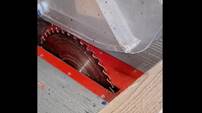 Let me give you an example from everyday life. Here is a
picture of perhaps my most favourite tool. It’s a bench saw, and I just love
it. With it I can cut pieces of wood into precise shapes. I can saw sheets of
wood to exact length and breadth. I can cut long strips of wood exactly in half
from top to bottom. I can make vertical cuts or angle cuts, and always in just
a few seconds. Many of the jobs I have done I couldn’t have managed without it.
Well one day I was cutting some wood with my usual joy and exuberance when
suddenly I felt a sharp pain in the top of my middle finger, and saw a spurt of
blood on the work surface. I realised to my horror that I had poked my finger
onto the fast rotating saw blade. Well, after a hurried trip to A&E, some
quick treatment by an understanding nurse, and the healing process that then
took over, my finger is now almost back to normal. I say almost, because the
top of the finger is still slightly deformed by the track made by the saw
blade. The nurse who attended to the wound nodded wisely and looked at me
meaningfully as I told her the story, but graciously she refrained from saying,
“Serves you right!” But of course it did serve me right. The table saw was
functioning in completely the right way, indeed the way that had previously
given me so much enjoyment, so it was completely right that my finger was cut. Nobody
quoted to me the scripture, “Be sure your sin will find you out,” but this
Bible verse correctly describes the situation. The word sin means shortcomings,
and when you are using a tool like a table saw you can be sure that any
shortcomings in the way you use it will find you out quickly. There are always
consequences to the way we behave, whether positive or negative.
Let me give you an example from everyday life. Here is a
picture of perhaps my most favourite tool. It’s a bench saw, and I just love
it. With it I can cut pieces of wood into precise shapes. I can saw sheets of
wood to exact length and breadth. I can cut long strips of wood exactly in half
from top to bottom. I can make vertical cuts or angle cuts, and always in just
a few seconds. Many of the jobs I have done I couldn’t have managed without it.
Well one day I was cutting some wood with my usual joy and exuberance when
suddenly I felt a sharp pain in the top of my middle finger, and saw a spurt of
blood on the work surface. I realised to my horror that I had poked my finger
onto the fast rotating saw blade. Well, after a hurried trip to A&E, some
quick treatment by an understanding nurse, and the healing process that then
took over, my finger is now almost back to normal. I say almost, because the
top of the finger is still slightly deformed by the track made by the saw
blade. The nurse who attended to the wound nodded wisely and looked at me
meaningfully as I told her the story, but graciously she refrained from saying,
“Serves you right!” But of course it did serve me right. The table saw was
functioning in completely the right way, indeed the way that had previously
given me so much enjoyment, so it was completely right that my finger was cut. Nobody
quoted to me the scripture, “Be sure your sin will find you out,” but this
Bible verse correctly describes the situation. The word sin means shortcomings,
and when you are using a tool like a table saw you can be sure that any
shortcomings in the way you use it will find you out quickly. There are always
consequences to the way we behave, whether positive or negative.
 So although we might not fully understand why the snakes
came, and we feel for the distress of the people, we can trust that God was
completely right in all he did. And what is so wonderful about this story is
not so much that they suffered the inevitable consequences of their terrible
attitude towards God, but that God intervened so mercifully and lovingly to
provide a way of escape. Now there are three things in particular I would like
us to consider from this account that Jesus said was a picture of his own death
for us on the cross.
So although we might not fully understand why the snakes
came, and we feel for the distress of the people, we can trust that God was
completely right in all he did. And what is so wonderful about this story is
not so much that they suffered the inevitable consequences of their terrible
attitude towards God, but that God intervened so mercifully and lovingly to
provide a way of escape. Now there are three things in particular I would like
us to consider from this account that Jesus said was a picture of his own death
for us on the cross.
The first is this. What an awful image it is, that serpent lifted up on a pole. If Jesus himself had not compared it so directly to his own death on the cross I am quite sure no-one would have dared to make the comparison. Certainly I am not aware of any Christian denomination that would depict the crucifixion using the image of a venomous snake. But the serpent is a picture of something truly wonderful. It wasn’t Jesus who was being dealt with and finished on the cross – it was sin and the consequences of sin. 2 Cor 5: 21 says, “God made him who had no sin to be sin for us, so that in him we might become the righteousness of God.” It was our sin that Jesus took with him to the cross, so that we instead might receive and share his righteousness.
The second lesson is this. The people of Israel needed faith to be healed, but that faith was expressed by the very simplest of actions – they just had to look at the bronze serpent to receive healing. They did not have to recite a creed, they did not have to go through weeks of training and preparation. They did not even have to wait until they felt their faith was strong enough. They just had to leave their tent and gaze at the bronze snake, and the faith that persuaded them to do that very simple act was enough for God to heal them. Jesus said, just as that happened in days long ago, so now those who see him lifted up on the cross and believe that he died to forgive them and to heal them, will receive eternal life. It doesn’t need a long and complicated prayer. When Peter was sinking beneath the waves on Galilee he just cried out, “Lord save me,” and Jesus reached out his hand and lifted him up. It doesn’t need a long, well-rehearsed statement of faith. Romans 10:9 says, “if you declare with your mouth, ‘Jesus is Lord,’ and believe in your heart that God raised him from the dead, you will be saved.”
The third thing to note is this. Both the Old Testament story and the New Testament account of Jesus dying on the cross for us reveal the amazing love of God for those who sin against him and deserve his judgement. How quickly God responded to the cry of his people for mercy when they were afflicted by the snakes in the desert. But the account of Christ dying on the cross for our sins speaks of a love far greater and far deeper. For he gave his one and only son to death on the cross that we might not perish but have eternal life. When writing to the Romans Paul said, “He who did not spare his own Son, but gave him up for us all – how will he not also, along with him, graciously give us all things?” (Rom 8: 32). If you leave this place with no other thoughts, go at least with this one. “I know I am loved by God with an everlasting love, because he gave his only son to die that I might receive everlasting life.”
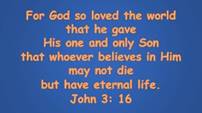 John 3 16 is one of the most learned and quoted verses in
the Bible. Two years ago it was a memory verse for our Holiday Bible Club. We
set it to music to help folk memorize it. Let’s just sing it together now as I
finish.
John 3 16 is one of the most learned and quoted verses in
the Bible. Two years ago it was a memory verse for our Holiday Bible Club. We
set it to music to help folk memorize it. Let’s just sing it together now as I
finish.
